Compliance
Singapore's advertising rules for clinics are strict, and creative built for unregulated beauty advertising is how clinics get into trouble. In practice you're working within the Healthcare Services Act and the Healthcare Services (Advertisement) Regulations administered by MOH, alongside the Singapore Medical Council (SMC) ethical guidelines.
Between them they restrict the kind of before/after imagery, testimonials, price promotions and superlative claims that dominate unregulated beauty advertising. Requirements are described here in practical terms — always confirm specifics with MOH or your own adviser.
Healthcare Services Act (HCSA)
Singapore clinic advertising now sits under the Healthcare Services Act (HCSA) and its advertisement regulations, which replaced the older PHMC publicity rules — our copy is checked against the current regime, and you can run the same check with the free MOH ad checker.
The three creative habits that fail fastest in Singapore:
- promo-price creative (treatment price promotions are restricted, and a "this month only" offer is a compliance flag in Singapore),
- before/after carousels (the workhorse of unregulated markets, restricted here — see the dedicated guide on this specific rule), and
- outcome testimonials (patient stories about results sit inside the restrictions, not outside them).
None of this means compliant advertising can't convert — it means the conversion has to come from education, practitioner credibility and a frictionless consultation pathway instead.
We wrote the full compliant structure up in the MOH-compliant aesthetic clinic playbook. Evaluating who runs this for you? See the guide to choosing a Singapore marketing agency.
PDPA and the DNC Registry
There's a second layer most clinics forget: PDPA and the Do Not Call (DNC) Registry.
The moment you collect a lead and follow up by call or SMS, DNC rules apply — so consent wording on the form and a compliant follow-up process aren't optional extras, they're part of the campaign. The practical setup is in our guide to DNC-safe lead follow-up in Singapore.
Two free tools
Two free tools help pressure-test creative and lead-handling against these two layers before a campaign launches.
Our MOH ad checker runs a proposed Singapore aesthetic-clinic headline, offer or landing-page block against the Healthcare Services (Advertisement) Regulations clause-by-clause, and the PDPA/DNC checker reviews consent wording and the follow-up flow against DNC-Registry requirements — the two failure surfaces that most often surprise clinics running their first Singapore campaign.
What "ethical" actually means for a Singapore aesthetic clinic's marketing
Ethical aesthetic practice in Singapore isn't a vague standard — the SMC's guidelines and the Advertisement Regulations define it concretely:
- no exploitation of a patient's insecurity to drive a booking,
- no advertising that implies a guaranteed outcome (bodies and skin respond differently, and claiming otherwise is itself the ethics violation, separate from being an advertising rule breach), and
- informed consent that happens in the consultation room, not the ad creative — an ad's job is to get a genuinely interested prospect to a real conversation with a practitioner, not to close the sale on results a photo can't promise.
Practically, that means our creative leads with practitioner credentials, treatment education and clinic environment rather than a transformation photo doing the persuasive work, and our qualification flow screens for genuine treatment fit before a consultation slot is booked
— an ethical funnel and a compliant one turn out to be the same funnel, built the same way.
- Review-content audit. Displayed Google reviews and testimonial content on the clinic's own website and social channels reviewed for compliance — a common gap, since many clinics don't realise a displayed review reading as an outcome testimonial sits inside the same restrictions as paid ad creative.
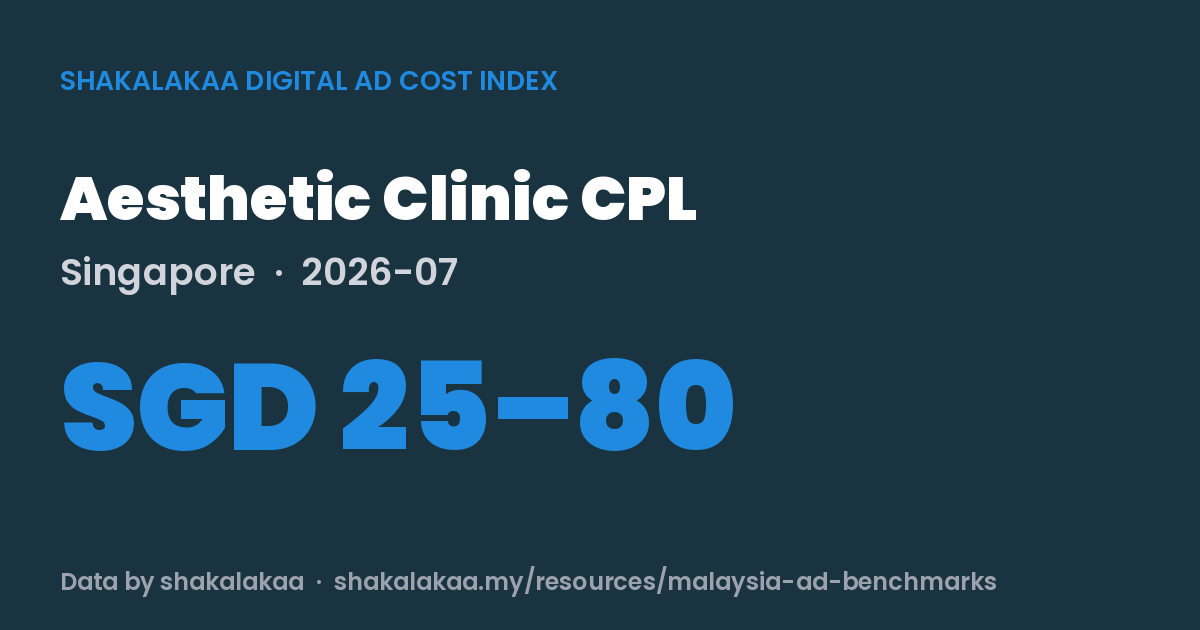
Singapore benchmarks (SGD)
Source: shakalakaa aggregated from managed accounts.